
Chapter 12
Molecular Structure
447
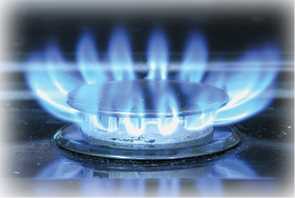
t’s Monday morning, and you’d like a cup of coffee, but when you try cranking up the stove to reheat yesterday’s brew, nothing happens. Apparently, the city gas line has sprung a leak and been shut down for repairs. The coffee cravings are strong, so you rummage in the garage until you find that can of Sterno left over from your last camping trip. You’re saved. Both Sterno and natural gas contain compounds that burn and release heat, but the compounds in each of these substances are different. Natural gas is mostly methane, CH4, while Sterno contains several substances, including methanol, CH3OH.
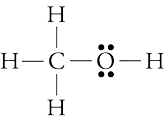
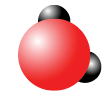
methane methanol
The oxygen atom in methanol molecules makes methanol’s properties very different than methane’s. Methane is a colorless, odorless, and tasteless gas. Methanol, or wood alcohol, is a liquid with a distinct odor, and is poisonous in very small quantities.
Chemists have discovered that part of the reason the small difference in structure leads to large differences in properties lies in the nature of covalent bonds and the arrangement of those bonds in space. This chapter provides a model for explaining how covalent bonds form, teaches you how to describe the resulting molecules with Lewis structures, and shows how Lewis structures can be used to predict the three-dimensional geometric arrangement of atoms in molecules.

Methane or methanol? We use both to heat food. How do their molecules—and properties—differ?
12.1 A New Look at Molecules and the Formation of Covalent Bonds
12.2 Drawing Lewis Structures
12.3 Resonance
12.4 Molecular Geometry from Lewis Structures
Given a periodic table, identify the number of the group to which each element belongs. (Section 2.3)
Given a chemical formula, draw a Lewis structure for it that has the most common number of covalent bonds and lone pairs for each atom. (Section 3.3)
Write or identify the definitions of valence electrons, electron-dot symbol, lone pairs,

Lewis structure, double bond, and triple bond. (Chapter 3 Glossary)
Write or identify the definition of atomic orbital. (Section 11.1)
Write electron configurations and orbital diagrams for the nonmetallic elements. (Section 11.2)
Review Skills
The presentation of information in this chapter assumes that you can already perform the tasks listed below. You can test your readiness to proceed by answering the Review Questions at the end of the chapter. This might also be a good time to read the Chapter Objectives, which precede the Review Questions.