


171
5.1 Classification of Matter
5.2 Compounds and Chemical Bonds
5.3 Ionic Compounds
5.4 Molecular Compounds
5.5 Drawing Lewis Structures
5.6 Resonance
5.7 Molecular Geometry from Lewis Structures
Review Skills
The presentation of information in this chapter assumes that you can already perform the tasks listed below. You can test your readiness to proceed by answering the Review Questions at the end of the chapter. This might also be a good time to read the Chapter Objectives, which precede the Review Questions.
Describe the particle nature of solids, liquids, and gases. (Section 3.1)
Convert between the names and symbols for the common elements. (Table 3.1)
Given a periodic table, write the number of the group to which each element belongs. (Figure 3.3)
Given a periodic table, identify the alkali metals, alkaline earth metals, halogens, and noble gases. (Section 3.3)
Using a periodic table, classify elements as metals, nonmetals, or metalloids. (Section 3.3)

Describe the nuclear model of the atom. (Section 3.4)
Define the terms ion, cation, and anion. (Section 3.4)
Define the terms covalent bond, molecule, and diatomic. (Section 3.5)
Describe the covalent bond in a hydrogen molecule, H2. (Section 3.5)
Write or identify the definition of atomic orbital. (Section 4.2)
Write electron configurations and orbital diagrams for the nonmetallic elements. (Section 4.3)
ook around you. Do you think you see anything composed of just one element…any objects consisting only of carbon, or of gold, or of hydrogen? The correct answer is almost certainly no. If you are lucky enough to have a diamond ring, you have a piece of carbon that is almost pure (although a gemologist would tell you that diamonds contain slight impurities that give each stone its unique character). If you have a “gold” ring, you have a mixture of gold with other metals, added to give the ring greater strength.
Even though a few elements, such as carbon and gold, are sometimes found in elemental form in nature, most of the substances we see around us consist of two or more elements that have combined chemically to form more complex substances called compounds. For example, in nature, the element hydrogen is combined with other elements, such as oxygen and carbon, in compounds such as the water and sugar used to make a soft drink. (Perhaps you are sipping one while you read.) In this chapter, you will learn to (1) define the terms mixture and compound more precisely, (2) distinguish between elements, compounds, and mixtures, (3) describe how elements combine to form compounds, (4) describe the characteristics of certain kinds of chemical compounds, and (5) describe how atoms in compounds are attached and how these atoms are arranged in space. The chapter will also expand your ability to visualize the basic structures of matter.
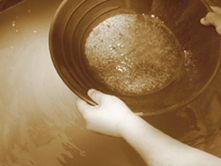
The flecks of gold in this pan are the only pure ele-ments visible in this scene.



Chapter 5
Chemical Compounds
