

Chapter 7
An Introduction to Chemical Reactions
299
ow that you understand the basic structural differences between different kinds of substances, you are ready to begin learning about the chemical changes that take place as one substance is converted into another. Chemical changes are chemists’ primary concern. They want to know what, if anything, happens when one substance encounters another. Do the substances change? How and why? Can the conditions be altered to speed the changes up, slow them down, or perhaps reverse them? Once chemists understand the nature of one chemical change, they begin to explore the possibilities that arise from causing other similar changes.
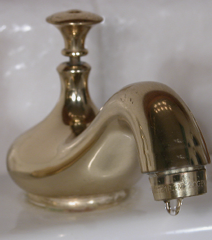
For example, let’s pretend that you just bought an old house as is, with the water turned off. On moving day, you twist the hot water tap as far as it will go, and all you get is a slow drip, drip, drip. As if the lack of hot water weren’t enough to ruin your day, you also have a toothache because of a cavity that you haven’t had time to get filled. As a chemist in training, you want to know what chemical changes have caused your troubles. In this chapter, you will read about the chemical change that causes a solid to form in your hot water pipes, eventually blocking the flow of water through them. In Chapter 6, you found out about a chemical change that will dissolve that solid, and a similar change that dissolves the enamel on your teeth is described in Chapter 8. Chapter 8 will also show you how fluoride in your toothpaste makes a minor chemical change in your mouth that can help fight cavities.
Chemical changes, like the ones mentioned above, are described with chemical equations. This chapter begins with a discussion of how to interpret and write chemical equations.
7.1 Chemical Reactions and Chemical Equations
7.2 Liquid Water and Water Solutions
7.3 Precipitation Reactions
7.4 Chemical Changes and Energy
Review Skills
The presentation of information in this chapter assumes that you can already perform the tasks listed below. You can test your readiness to proceed by answering the Review Questions at the end of the chapter. This might also be a good time to read the Chapter Objectives, which precede the Review Questions.
Write the formulas for the diatomic elements. (Section 3.5)
Write the definitions of energy, kinetic energy, and potential energy. (Chapter 4 Glossary)
Describe the relationship between stability, capacity to do work, and potential energy. (Section 4.1)
Explain why energy must be absorbed to break a chemical bond. (Section 4.1)
Explain why energy is released when a chemical bond is formed. (Section 4.1)

Describe the changes that take place during heat transfer between objects at different temperatures. (Section 4.1)
Predict whether a bond between two atoms of different elements would be a covalent bond or an ionic bond. (Section 5.2)
Convert between the names and formulas for alcohols, binary covalent compounds, and ionic compounds. (Sections 6.1, 6.2, 6.4, and 6.5)


A chemical reaction causes solids to form in hot water pipes.