
Chapter 9
Chemical Calculations and Chemical Formulas
329
n order to explore and make use of the seemingly limitless changes that matter can undergo, chemists and chemistry students often need to answer questions that begin with, “How much…?” The research chemist who is developing a new cancer drug wants to know, “How much radioactive boron-10 do I need to make 5 g of the drug?” At a chemical plant where the fat substitute Olestra is manufactured from white sugar and vegetable oil, a business manager asks a chemist, “How much sucrose and cottonseed oil should I order if we need to produce 500 Mg of Olestra per day?” In an experiment for a chemistry course you are taking, you might be asked, “How much magnesium oxide can be formed from the reaction of your measured mass of magnesium with the oxygen in the air?” This chapter and the chapters that follow provide you with the tools necessary to answer these questions and many others like them.
9.1 A Typical Problem
9.2 Relating Moles to Number of Particles
9.3 Molar Mass and Chemical Compounds
9.4 Relationships Between Masses of Elements and Compounds
9.5 Determination of Empirical and Molecular Formulas
Write or recognize the definition of isotope. (Section 2.4)
Describe the general structure of molecular and ionic compounds. (Sections 3.3 and 3.5)
Convert between the names of compounds and their chemical formulas. (Section 5.3)

Report the answers to calculations to the correct number of significant figures. (Section 8.2)
Use percentages as conversion factors. (Section 8.4)
Make unit conversions. (Section 8.5)
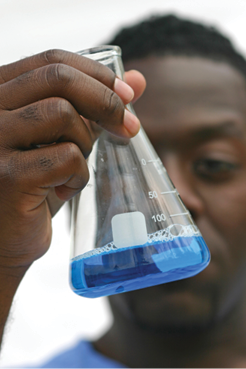
All of these people ask questions that begin, “How much...?”
Review Skills
The presentation of information in this chapter assumes that you can already perform the tasks listed below. You can test your readiness to proceed by answering the Review Questions at the end of the chapter. This might also be a good time to read the Chapter Objectives, which precede the Review Questions.